How to Choose a Custom Software Development Company
A custom software development company is not simply a source of engineering capacity. For a platform modernization, a new digital product, or a data-intensive operational system, the partner you choose will influence architecture decisions that remain visible years after launch. The real question is whether that team can take responsibility for a production outcome, not just complete a backlog of tickets.
That distinction matters most when the initiative involves distributed services, sensitive data, multiple cloud environments, legacy dependencies, or a release schedule tied to real business commitments. A weak delivery model can produce working software and still leave your internal team with unstable releases, unclear ownership, mounting cloud costs, and an architecture that becomes harder to change each quarter.
What a Custom Software Development Company Should Own
Custom development is often described as building an application to a company’s requirements. That definition is too narrow for strategic work. Production software depends on far more than application code: technical discovery, domain modeling, architecture, infrastructure, automated delivery, security controls, observability, incident response, and operational documentation all affect whether the system performs when customers and internal teams depend on it.
A capable partner starts by identifying the constraints that shape the solution. These may include existing systems of record, regulatory obligations, service-level expectations, growth forecasts, data retention needs, and the skills of the team that will operate the platform over time. Requirements matter, but requirements without constraints tend to produce designs that look good in planning and fail under real operating conditions.
Ownership does not mean a vendor makes every decision in isolation. It means engineers bring clear recommendations, explain trade-offs, document decisions, and remain accountable for implementing the result. If an event-driven design adds operational complexity, the team should say so. If a managed cloud service reduces maintenance but creates a meaningful dependency, that should be part of the decision record. Sound engineering is not about choosing the most advanced pattern. It is about selecting a pattern your organization can support.
Evaluate Delivery Capability, Not Just Technical Keywords
Most firms can describe experience with current frameworks, cloud providers, and deployment tools. Those terms are table stakes. A better evaluation looks at how a team turns technical expertise into predictable delivery.
Start with discovery. Before a development team estimates a large initiative, it should be able to explain what it needs to learn: the business workflow, the current architecture, data quality, integration boundaries, nonfunctional requirements, and key delivery risks. A credible discovery phase produces an actionable plan rather than a polished set of assumptions. That plan should establish the first releases, architectural decisions that cannot be deferred, dependencies requiring client input, and measures for success.
Then examine how the company manages engineering quality during execution. Ask how code is reviewed, how environments are provisioned, how deployments are promoted, and what happens when a production release fails. Look for practical answers involving CI/CD, infrastructure as code, test strategy, alerting, logging, tracing, and rollback procedures. These practices are not separate operations work added at the end. They are part of building software that can be changed safely.
It is also useful to ask who is accountable when a cross-functional issue appears. A feature may involve application logic, an API integration, a database migration, cloud permissions, and a dashboard for operational visibility. Staff augmentation models can place the coordination burden on the client because each contributor owns a narrow assignment. An accountable engineering partner organizes the work across those boundaries and treats the delivered system as its responsibility.
Seniority Must Be Visible in the Work
Senior engineers do more than write faster code. They recognize failure modes early, challenge incomplete assumptions, and avoid decisions that create hidden costs for the next team. Their value is especially clear when a project has conflicting priorities: speed to market, a constrained budget, an inherited platform, and a need for high availability.
During evaluation, ask to meet the people who will lead architecture and delivery, not only the commercial team. Discuss a realistic scenario from your environment. For example, how would they migrate a high-traffic workflow without a prolonged outage? How would they separate a reporting workload from a transactional system? How would they manage schema changes when several consumers depend on the same event stream?
The quality of the response matters more than a single preferred answer. Strong teams identify missing information, state assumptions, and describe a staged path that reduces risk. Be wary of instant certainty when the technical context is incomplete.
Architecture Should Support Change, Not Just Launch
Many software projects are judged at launch. That is understandable, but it is a poor stopping point for architecture. Once users rely on a system, the critical question becomes how safely it can evolve.
A solid architecture has clear boundaries between components, intentional data ownership, and interfaces that can change without forcing a full rewrite. It does not always require microservices. In fact, a modular monolith can be the better choice for a product that needs speed, limited operational overhead, and a small number of independent domains. Microservices are appropriate when scaling, team autonomy, fault isolation, or independent deployment needs justify their added complexity.
The same discipline applies to data. Data platforms need defined contracts, lineage, quality checks, access controls, and ownership. Without them, a lakehouse or streaming pipeline can become another source of untrusted reports and expensive rework. A development partner should connect application design to data operations, especially when operational events feed analytics, customer reporting, machine learning, or compliance processes.
Cloud architecture deserves the same scrutiny. Moving workloads to AWS, Azure, or GCP does not automatically improve resilience or lower cost. The right design depends on traffic patterns, recovery objectives, regional requirements, managed-service fit, and the organization’s ability to operate the environment. Multi-region deployment can improve availability, but it also raises complexity around data consistency, failover testing, and cost. It should be a deliberate response to business requirements, not a default diagram.
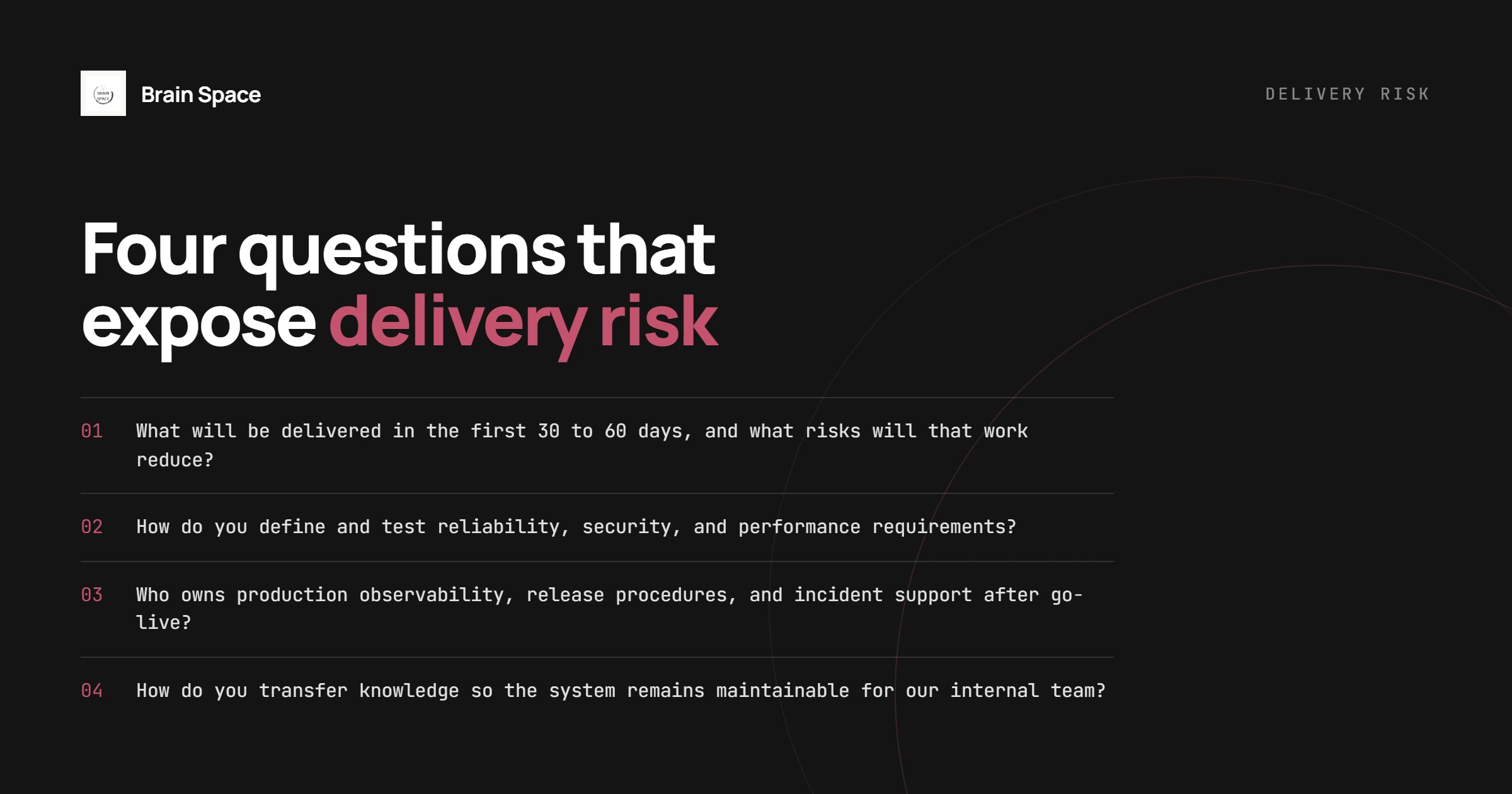
Questions That Expose Delivery Risk
The best conversations are specific. Rather than asking whether a company has cloud experience, ask how it establishes production readiness. Rather than asking whether it uses agile methods, ask how it handles a dependency that blocks a planned release.
Four questions tend to reveal how a team works:
What will be delivered in the first 30 to 60 days, and what risks will that work reduce?
How do you define and test reliability, security, and performance requirements?
Who owns production observability, release procedures, and incident support after go-live?
How do you transfer knowledge so the system remains maintainable for our internal team?
A reliable answer should include artifacts and operating practices, not vague assurances. You should hear about architecture records, prioritized backlogs, deployment pipelines, runbooks, service dashboards, on-call expectations, and documented handover plans. The exact process will vary by engagement, but the accountability should remain clear.
Build the Engagement Around Decisions
The commercial structure should support good technical decisions. Fixed scope can work for a well-understood, bounded implementation. It becomes risky when discovery is incomplete or the work depends on uncertain integrations and legacy behavior. In those situations, a phased engagement is often more honest: establish the architecture and delivery plan, build a thin production-capable slice, then expand based on evidence.
Embedded teams can be effective when your organization has strong product and technical leadership but needs additional senior capacity. Project-based delivery can be more suitable when you need a partner to take broader responsibility for an outcome. Neither model is inherently better. The important point is to match the model to your internal ability to make decisions, provide domain access, and operate what is delivered.
Brain Space approaches this work as an accountable engineering responsibility across software, cloud, and data rather than a collection of disconnected roles. That model is valuable when coordination itself is one of the project’s largest risks.
The right partner will not promise that every unknown can be removed before work begins. Instead, it will make uncertainty visible, reduce it in the right order, and leave your organization with a system that is easier to operate than the one it replaced. That is the standard worth using when the software matters to the business.