Cloud Migration Consulting Services That Deliver
A migration can look complete on a program dashboard while the platform is harder to operate than the system it replaced. Costs rise without clear unit economics, releases slow down, and the team discovers that a production incident now depends on services nobody fully understands. Cloud migration consulting services should prevent that outcome by treating migration as an engineering and operating-model change, not a hosting move.
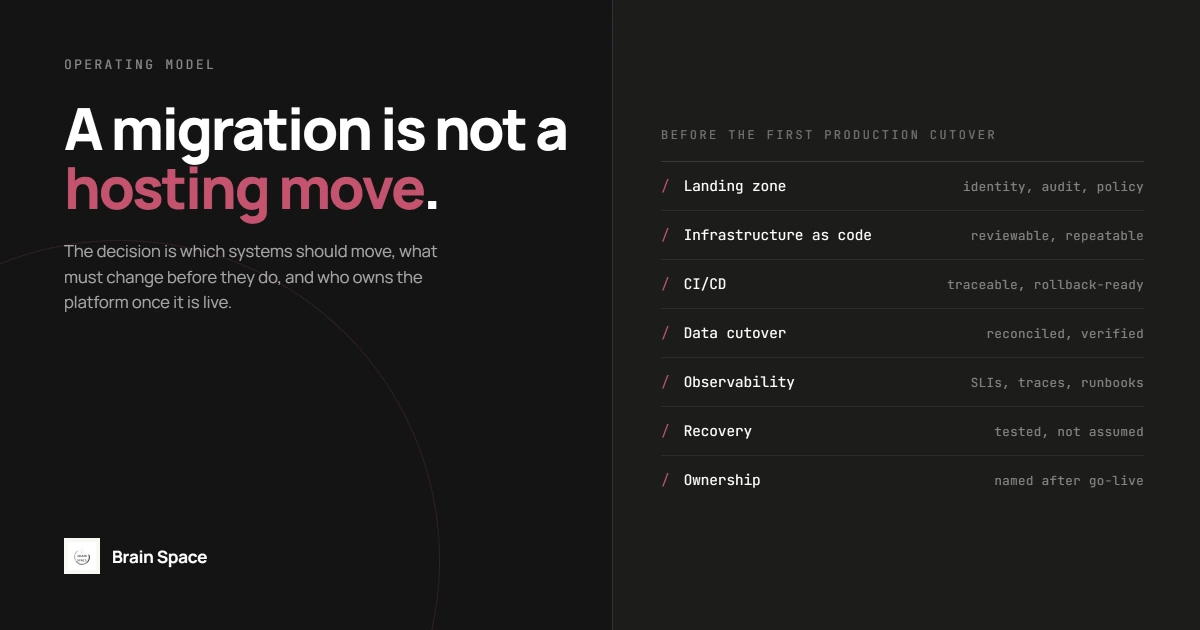
For CTOs and engineering leaders, the real decision is not whether to move workloads to AWS, Azure, or GCP. It is which systems should move, what must change before they do, and who will own the platform once it is live. The answers determine whether the cloud improves delivery capacity or simply relocates existing technical debt.
What cloud migration consulting services should own
A credible consulting partner takes responsibility for the path from technical discovery through production operations. That means working across application architecture, infrastructure, security, delivery pipelines, data movement, and service reliability. Handing over a set of cloud diagrams or a list of recommendations is not enough when the work involves critical systems, customer data, and revenue-bearing workloads.
The engagement should begin with a clear view of the existing estate. That includes application dependencies, data stores, integration patterns, traffic profiles, operational pain points, compliance obligations, and recovery requirements. Inventory alone has limited value. Leaders need to know which dependencies will constrain the sequence of work and which systems can be retired rather than migrated.
From there, the team should establish a migration rationale for each workload. Not every application deserves the same treatment. A stable internal tool nearing retirement may be moved with limited change. A customer-facing platform with unpredictable demand may require a redesign around horizontal scaling, caching, asynchronous processing, and stronger observability. A shared data platform may need governed ingestion, data contracts, lineage, and retention policies before any cutover is safe.
A practical workload strategy generally includes four paths:
Retire systems that no longer create business value or duplicate another capability.
Retain workloads that are constrained by licensing, latency, hardware, or a near-term replacement plan.
Rehost applications when speed matters and architectural change would create unnecessary delivery risk.
Replatform or refactor systems where cloud-native capabilities will materially improve reliability, throughput, deployment speed, or cost control.
The right mix depends on business timing. A full rewrite may be technically appealing but commercially wrong if a contract renewal, market launch, or data center exit has a fixed date. Conversely, a lift-and-shift can be a reasonable first move, provided it is not presented as the final architecture.
Start with architecture and operating constraints
Migration programs fail when their critical assumptions remain implicit. A consulting team should surface them early: required recovery point and recovery time objectives, regional availability needs, identity boundaries, data residency, release windows, peak-load behavior, and acceptable downtime. These are design inputs, not implementation details to revisit during the final cutover.
This work also reveals where a legacy system has hidden operational dependencies. Many applications rely on scheduled jobs running on a single server, unversioned database scripts, manually maintained firewall rules, or a specific engineer's knowledge of an integration. Moving those dependencies unchanged into cloud infrastructure makes them less visible, not less risky.
The target architecture should be specific enough to build against. For a production platform, that commonly means defined account or subscription structure, network segmentation, identity and access controls, encryption standards, logging destinations, backup policies, and infrastructure-as-code conventions. It should also define the interfaces between application teams and platform operations so ownership does not dissolve after launch.
For distributed systems, architecture decisions need extra care. Splitting a monolith into services can improve independent deployment and scaling, but it also introduces network failures, data-consistency decisions, versioned APIs, and more operational surface area. There are cases where a well-structured modular monolith running on managed cloud services is the more reliable interim destination. The goal is solid architecture that matches the organization's ability to operate it.
Build the landing zone before moving critical workloads
The first migrated application should not become the mechanism for discovering basic cloud controls. Before production workloads arrive, the environment needs a usable landing zone: identity federation, least-privilege access patterns, centralized audit logs, network controls, secrets management, baseline monitoring, and policy enforcement through code.
This foundation should be repeatable. Infrastructure as code allows environments to be reviewed, recreated, and changed through the same delivery discipline as application software. It reduces configuration drift and provides a practical record of what exists. But tools alone do not create control. Teams still need ownership for module standards, change review, exceptions, and the lifecycle of shared infrastructure.
CI/CD also deserves attention before migration accelerates. An application that takes weeks to release in the data center will not gain much from cloud hosting alone. Build pipelines should produce traceable artifacts, automate security and quality checks, promote changes consistently across environments, and support rollback or progressive delivery when the risk warrants it.
Treat data migration as a product risk
Data is often the part of a migration with the least tolerance for approximation. Moving a database is not just a transfer exercise. The team must account for schema compatibility, data quality, encryption, replication lag, retention requirements, reconciliation, and the behavior of downstream consumers.
The cutover approach should be chosen deliberately. A short outage may be acceptable for a back-office system. A customer platform may require change data capture, dual-running periods, or phased routing to reduce interruption. Each option has trade-offs: dual writes can create consistency problems, while prolonged parallel operation increases cost and operational complexity.
Verification must extend beyond row counts. Teams should test business-critical reports, payment or order flows, search indexes, events, and integrations that consume migrated data. A migration is not complete because the database is available. It is complete when the business process works correctly under production conditions.
Make observability part of the definition of done
Cloud platforms generate more telemetry, but more logs do not automatically produce faster incident response. Engineers need useful service-level indicators, actionable alerts, distributed traces for critical paths, and dashboards that connect infrastructure behavior to user impact.
This is particularly important when workloads span multiple services, regions, or third-party systems. A rising error rate needs an owner and a runbook. A queue backlog needs thresholds that reflect customer impact rather than arbitrary infrastructure limits. Capacity planning needs actual load data, not a one-time estimate made during architecture workshops.
Resilience should be validated through exercises, not assumed from a diagram. Test backup restoration, zone failure behavior, credential rotation, deployment rollback, and failover procedures. Multi-region architecture can reduce certain risks, but it also adds data replication, routing, and operational complexity. For some workloads, tested backups and a well-practiced recovery process provide better value than active-active deployment.
Choose a partner built for delivery accountability
When evaluating cloud migration consulting services, ask who will make technical decisions, build the platform, migrate the applications, and remain accountable during stabilization. A model based on individual staff augmentation can work when a client already has strong internal architecture and program leadership. It creates gaps when no one owns the end-to-end outcome.
Look for a team that can connect discovery findings to implementation plans, estimate work in delivery increments, and identify decisions that require executive input. The program should have measurable milestones: landing-zone readiness, migrated workload acceptance, recovery validation, cost baselines, decommissioned legacy components, and operational handover criteria.
Cost should be managed as an engineering concern from the start. Early estimates are useful for investment planning, but real optimization begins with workload telemetry. Rightsizing, storage lifecycle policies, managed-service choices, committed-use decisions, and architecture changes should be evaluated against performance and resilience requirements. The cheapest design on paper can be expensive if it consumes scarce engineering time or fails under peak demand.
Brain Space approaches this work as a production delivery responsibility. Senior engineers can carry architecture, application modernization, infrastructure automation, data pipelines, and operational readiness through a single coordinated engagement, reducing the handoffs that commonly slow migration programs.
A well-run migration leaves an organization with more than workloads in a new location. It leaves a platform that teams can change with confidence, observe under pressure, and operate without relying on undocumented knowledge. That is the standard worth setting before the first production cutover.