Enterprise Software Engineering That Holds Up
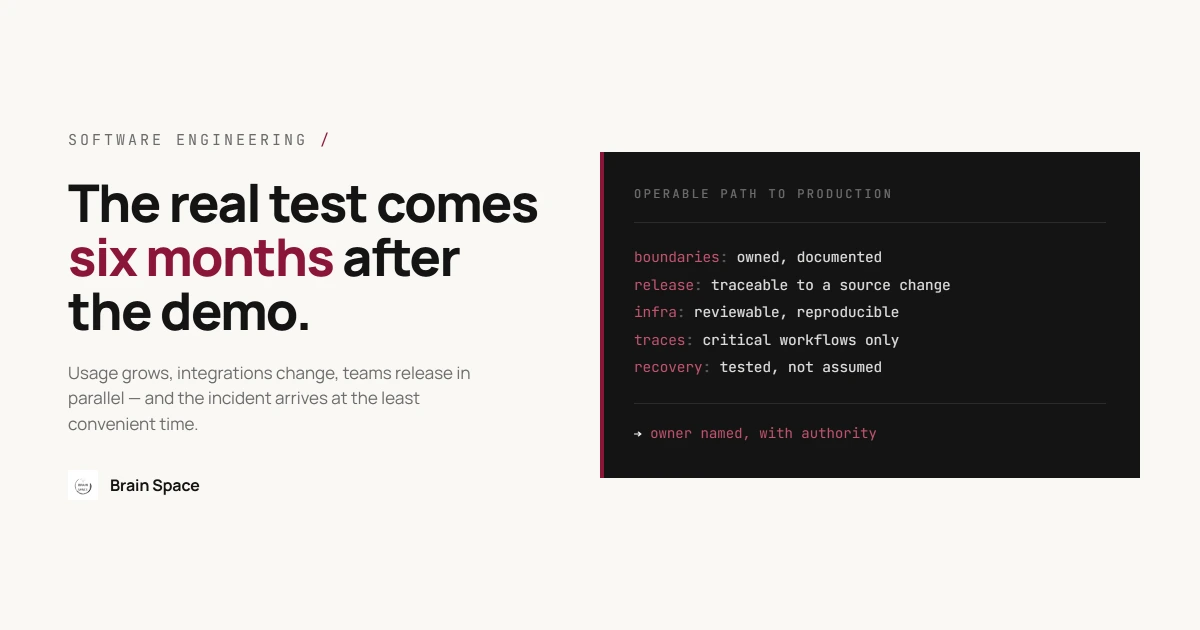
A platform can look successful in a demo and still fail the business six months later. The real test of enterprise software engineering is whether the system remains dependable when usage grows, integrations change, teams release in parallel, and an operational incident arrives at the least convenient time.
That distinction matters because enterprise systems rarely operate in isolation. They support revenue workflows, customer experiences, internal operations, regulatory obligations, and decisions made from business data. A weak boundary between services, an undocumented dependency, or an untested recovery path can become an expensive constraint long after the original feature has shipped.
Enterprise Software Engineering Is a Delivery Discipline
Enterprise software engineering is often reduced to application development. That framing is too narrow. Production software is the combined result of product decisions, architecture, application code, infrastructure, data movement, release practices, security controls, and day-two operations.
The difficult work is not selecting a fashionable framework. It is making clear technical decisions under real constraints: existing platforms, contractual deadlines, security requirements, budget limits, organizational ownership, and years of accumulated behavior that may not be documented anywhere.
A delivery team needs to understand what must be stable, what can change, and where failure is acceptable. A customer-facing checkout flow and an internal reporting job should not receive the same availability target, recovery design, or engineering investment. Treating every component as mission-critical inflates cost and complexity. Treating all components as low-risk creates fragility where the business cannot afford it.
The goal is not perfection. It is a system whose risks are understood, whose critical paths are protected, and whose teams can change it without creating avoidable operational exposure.
Start With System Boundaries, Not a Feature Backlog
Feature backlogs express demand. They do not explain system behavior. Before large-scale delivery begins, teams need a practical view of the current environment: users and workflows, system dependencies, data sources, integration patterns, operational ownership, and the constraints imposed by security or compliance.
This work is often called discovery, but it should produce decisions rather than a slide deck. For example, a technical discovery should establish whether a legacy application is a candidate for incremental modernization or whether it needs containment while a replacement is built. It should clarify which services own which data, how identity and access are managed, and what happens if a downstream partner system is unavailable.
The same applies to architecture. A service boundary is useful when it creates a meaningful ownership and deployment boundary. Splitting an application into many services before teams have the operational maturity to support them can increase failure modes, deployment overhead, and debugging time. A well-structured modular application may be the better choice when a product is still evolving quickly or the domain remains tightly coupled.
Architecture should therefore be judged by operational consequences. Can teams release independently where they need to? Can they trace a transaction across components? Can they restore service after a dependency fails? Can a new engineer understand where a business rule belongs? Those questions are more useful than a diagram with a large number of boxes.
Build for Change Without Designing for Every Possibility
Enterprise platforms must evolve, but speculative flexibility is not the same as adaptability. Teams commonly over-engineer extension points, generalized data models, or distributed architectures for future scenarios that never arrive. The result is slower delivery and more complicated operations.
A better approach is to make the changes that are likely both safe and inexpensive. Use clear domain boundaries, explicit API contracts, versioned interfaces where external consumers depend on them, and automated tests around behavior that cannot break. Keep deployment and configuration separate from application logic. Capture decisions that future teams will need to revisit.
Data deserves particular care. Many enterprise failures begin as mismatched assumptions about meaning rather than outages. If one system defines an active customer differently from another, a technically successful pipeline can still produce incorrect reporting, inaccurate automation, or poor customer communication.
Data contracts make those assumptions explicit. They define ownership, schema expectations, quality rules, and how changes are introduced. In event-driven and streaming environments, they also help prevent a producer change from quietly disrupting many downstream consumers. A lakehouse or event stream can improve access to data, but it does not replace governance over what the data represents.
Reliable Delivery Requires an Operable Path to Production
A release process that depends on manual coordination, undocumented environment changes, or one person with production knowledge is not reliable delivery. It may work until delivery speed increases or that person is unavailable.
CI/CD, infrastructure as code, and automated validation are not administrative overhead. They are the mechanisms that make change repeatable. A production release should be traceable to a source change, tested against appropriate environments, and deployable through a defined process. Infrastructure should be reviewable, reproducible, and recoverable rather than assembled through console changes that disappear from institutional memory.
The right level of automation depends on the system. A regulated workflow may require formal approval gates. A high-volume digital product may benefit from progressive delivery, feature flags, and automated rollback criteria. In both cases, the essential principle is the same: release controls should match the risk of the change and provide evidence that the system is behaving as expected.
Observability completes that path. Logs alone are not enough when a transaction crosses APIs, queues, databases, and third-party services. Teams need meaningful metrics, traces for critical workflows, actionable alerts, and dashboards that reflect customer and business impact. An alert that says CPU usage is high may be useful. An alert that shows payment authorization failures are rising is usually more urgent.
Operations Are Part of the Engineering Scope
Production ownership changes design decisions for the better. Engineers who expect to support a system think differently about timeout policies, retry behavior, dependency failures, capacity limits, and diagnostic information. They ask how an operator will identify a failed job at 2 a.m., not just whether the happy path passes a test.
Resilience does not always require multi-region active-active deployment. That approach can be appropriate for certain critical workloads, but it brings substantial complexity in data consistency, failover, cost, and operational practice. For other systems, a well-tested backup and restore process, a secondary recovery environment, and clear recovery objectives may offer a more sensible balance.
What matters is making the decision deliberately. Define recovery time and recovery point objectives with the business. Test the recovery process instead of assuming backups are usable. Practice incident response with the people who will actually operate the platform. Post-incident reviews should identify contributing conditions and corrective actions, not search for an individual to blame.
This is where fragmented vendor models often break down. One provider builds the application, another manages cloud infrastructure, and a third owns data pipelines. When an incident spans all three, the client becomes the coordinator. An accountable engineering partner takes responsibility across those boundaries, including the difficult work of diagnosing where the fault originated and getting the system back to a stable state.
What Good Enterprise Engineering Changes for Leadership
For technical leaders, the output of good engineering is not merely a set of completed tickets. It is increased decision-making capacity. Teams can estimate change with more confidence because dependencies are visible. They can release more often because deployment is controlled. They can respond to incidents faster because system behavior is observable.
It also improves commercial outcomes. A maintainable platform reduces the cost of entering new markets, integrating an acquired product, responding to customer requirements, or introducing a new operating model. The return is not always immediate or easily attributed to a single architecture decision. It becomes visible when the organization faces a high-stakes change and the platform is not the reason it has to slow down.
At Brain Space, this means treating architecture, cloud engineering, data platforms, and application delivery as one production responsibility. The work does not end when software is deployed. It ends when the team can operate, improve, and trust what was built.
The most useful question to ask of an enterprise initiative is simple: after this system goes live, who owns the outcome? If the answer is clear, and that owner has the authority, tooling, and engineering discipline to act, the project has a far better chance of holding up when real operating conditions arrive.