Event Streaming Architecture: Design Patterns, Best Practices, and Common Pitfalls
A customer changes an address, a payment clears, inventory falls below a threshold, or a shipment is delayed. In a well-designed event streaming architecture, those facts become durable records that multiple systems can use without tightly coupling their release schedules, databases, or availability. That is the promise. The hard part is making the promise hold when messages arrive late, services fail, schemas change, and traffic spikes at the least convenient moment.
Event streaming is not a shortcut to a modern platform. It is an architectural commitment to treating business activity as a sequence of immutable facts, then operating the infrastructure and engineering practices needed to make those facts trustworthy.
What Event Streaming Architecture Actually Changes
Traditional integration often relies on synchronous APIs, scheduled extracts, and point-to-point jobs. These approaches can work well for a limited number of systems. As the platform grows, however, they create dependency chains that are difficult to reason about. A customer-facing application may need an order service, payment provider, fraud engine, fulfillment system, and notification service to be available within the same request path.
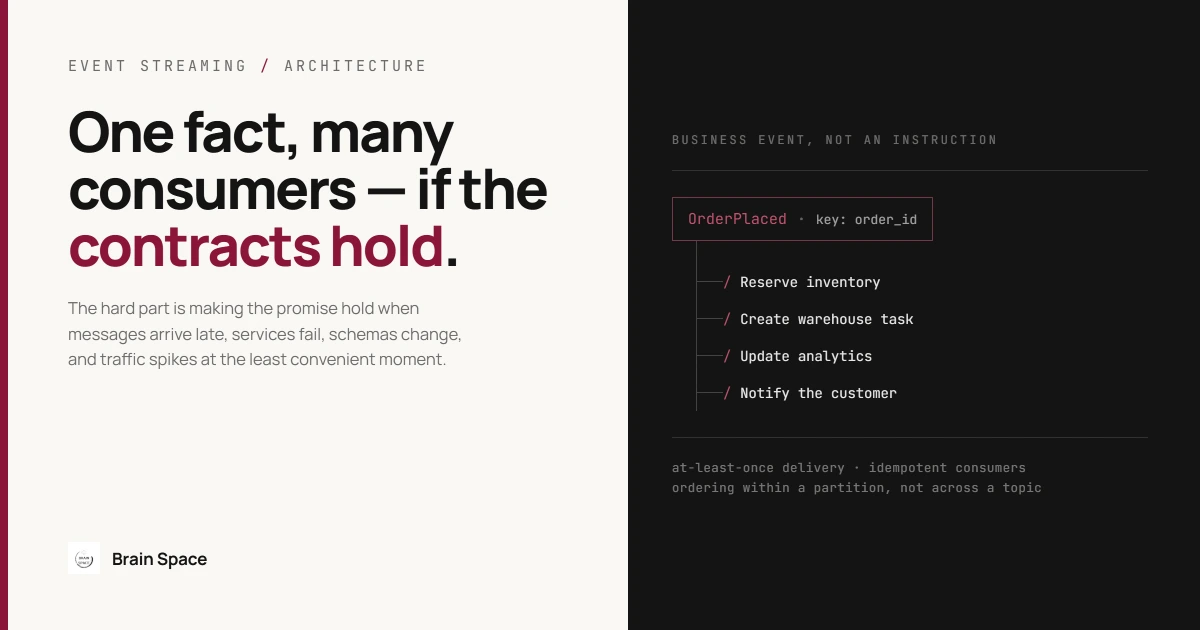
An event streaming architecture changes the interaction model. A producer publishes an event, such as OrderPlaced. Consumers process it independently for their own responsibilities: reserving inventory, creating a warehouse task, updating analytics, or notifying the customer. The producer does not need to know which consumers exist, and a new consumer can often be introduced without changing the producing application.
That decoupling improves change velocity, but it does not remove dependencies. It moves them into contracts, topic design, consumer behavior, retention settings, and operational controls. Teams that view a streaming platform as merely a message broker often discover this after the first difficult incident.
Start With Business Events, Not Topics
The most durable designs begin with the business domain. An event should communicate something that happened in the business, not a technical instruction for another service to execute. PaymentAuthorized is generally a stronger event than UpdatePaymentStatus, because it records a fact rather than exposing a workflow command.
This distinction matters when consumers evolve. Facts can serve uses that were not anticipated when the event was created. A finance system, customer support tool, risk model, and lakehouse pipeline may all need a reliable record that a payment was authorized. A command tailored to one downstream system creates a tighter and more fragile dependency.
Events should include enough context for consumers to act predictably, while avoiding unnecessary duplication of sensitive data. A common pattern is to include an event ID, event type, timestamp, entity identifier, correlation ID, producer version, and the state needed for the event’s intended use. The exact payload is domain-specific. Large, frequently changing documents often belong in an authoritative service or object store, with the event carrying a stable reference and meaningful change metadata.
The goal is not to design a universal event envelope that solves every case. It is to establish conventions that let engineers trace activity, manage compatibility, and distinguish business meaning from transport details.
Define ownership before publishing
Every event stream needs a clear owner. That owner is accountable for the event’s semantics, schema evolution, data quality, service-level expectations, and deprecation path. Platform teams can provide shared infrastructure, templates, access controls, and observability. They should not become the default owners of every business contract.
Without explicit ownership, a topic becomes shared territory. Producers make breaking changes under delivery pressure, consumers infer undocumented behavior, and no team has authority to resolve the resulting ambiguity.
Partitioning Is a Business Decision With Technical Consequences
Streaming systems distribute load through partitions or equivalent units of parallelism. The chosen key determines which events are processed in order relative to one another. That makes partitioning a domain decision, not a tuning detail to postpone.
For an order lifecycle, partitioning by order ID usually preserves the sequence of events for that order. For inventory, a SKU or warehouse-SKU key may be more appropriate. There is no single correct key across a platform. The important question is: which events must be ordered together for a consumer to produce correct outcomes?
Ordering is typically guaranteed only within a partition, not across an entire topic. Designs that assume global ordering may work in test environments and fail under real throughput. Similarly, an uneven key distribution can create hot partitions, where one popular account, product, or tenant limits the throughput of the whole stream.
Partition count also deserves early consideration. Increasing parallelism later is possible in many platforms, but it can affect key distribution, consumer behavior, and cost. Capacity planning should use realistic event volume, payload size, peak rates, retention requirements, and replay scenarios, not average traffic alone.
Delivery Guarantees Need Plain Language
Teams often ask whether a streaming platform provides exactly-once delivery. The useful answer is usually more precise: exactly once where, under what failure conditions, and with which external systems?
At-most-once processing can lose events. At-least-once processing can deliver duplicates. Exactly-once processing can be achievable within certain transactional boundaries, but it does not automatically make an email provider, payment gateway, legacy database, or downstream API idempotent.
For most production workflows, the practical baseline is at-least-once delivery with idempotent consumers. Consumers should safely handle the same event more than once, typically by recording processed event IDs, using natural business keys, or applying state changes that are inherently repeatable. The choice depends on storage technology, throughput, and the cost of duplication.
A related issue is the dual-write problem. If an application updates its database and publishes an event separately, one operation can succeed while the other fails. The transactional outbox pattern addresses this by recording the business change and the outbound event in the same database transaction. A separate process then publishes the outbox record and retries safely. It adds operational components, but it prevents a class of silent data inconsistency that is expensive to repair later.
Design for Replay, Failure, and Recovery
A stream is valuable partly because consumers can replay historical events. Replay supports recovery, new projections, audit investigations, and backfills into analytics systems. It is also dangerous if a consumer was written with one-time side effects in mind.
Before approving a consumer, teams should know what happens if it reprocesses a day, a month, or a full retention window of events. Will it resend notifications? Recreate invoices? Overwrite a current-state projection with stale data? The answers drive idempotency, event versioning, and how side effects are isolated.
Failure handling should avoid a simplistic retry loop. Transient errors may justify exponential backoff. Invalid payloads, missing reference data, or permanent authorization failures require a different path. Dead-letter streams can preserve problematic events for investigation, but they are not a resolution mechanism by themselves. An unmonitored dead-letter topic is a delayed production incident.
Operational runbooks should establish who investigates failed events, how messages are corrected or replayed, when a consumer offset can be reset, and how teams protect downstream systems during catch-up. These decisions turn streaming from an integration pattern into an operable service.
Govern Schemas as Product Contracts
Schema changes are among the most common causes of streaming failures. Adding an optional field may be compatible. Renaming a field, changing a data type, or altering the meaning of an existing value may not be. Producers and consumers often deploy independently, so compatibility must be enforced before runtime.
A schema registry or equivalent contract-management process gives teams a controlled way to validate changes. More importantly, it creates a review point for semantic compatibility. A field that remains technically valid can still become misleading if its business definition changes.
Data contracts should specify the owner, allowed use, classification, retention expectation, freshness expectation, and compatibility policy. This is particularly important when operational events also feed analytics, machine learning, or regulated reporting. A stream that works for application integration may need additional controls before it becomes a broadly accessible data source.
Observability Must Follow the Event
Infrastructure metrics are necessary but insufficient. Broker CPU, storage, consumer lag, and throughput indicate platform health, yet they cannot tell an operations team whether a customer’s cancellation reached the fulfillment service.
Production observability should connect technical telemetry to business flow. Correlation IDs, trace context, consumer processing times, failure reasons, and lag by consumer group make it possible to follow an event across service boundaries. Teams also need business-level signals: orders accepted but not fulfilled, payments authorized without settlement, or unusually high rates of rejected inventory updates.
Alerting requires restraint. A small amount of consumer lag may be normal during peak load; growing lag paired with missed service objectives is not. Thresholds should reflect recovery time, retention windows, and business impact rather than a generic zero-lag target.
Build the Platform as a Product
Organizations with several event producers and consumers benefit from a shared streaming platform. That platform should provide secure provisioning, topic standards, infrastructure as code, role-based access, schema validation, dashboards, retention controls, and deployment patterns. The aim is to make the safe path easier than the improvised path.
Centralization has limits. A platform team that becomes a ticket queue for every topic and schema change will slow delivery and lose domain context. The stronger model is a product platform with self-service guardrails and clear accountability retained by domain teams.
Brain Space approaches these programs as production engineering work: architecture, application changes, cloud infrastructure, CI/CD, data contracts, observability, and operating procedures must align. A reliable stream is not created by selecting a broker. It is created by engineering the full path from business event to measurable outcome.
The best first implementation is usually narrow but consequential: one bounded business flow with clear ownership, real consumers, meaningful failure cases, and defined operational measures. Prove that the team can publish, govern, observe, replay, and recover that flow. Then expand from evidence rather than enthusiasm.