Legacy Code Doesn't Have to Be a Nightmare: A Practical Guide to Incremental Modernization
Legacy Code Doesn't Have to Be a Nightmare: A Practical Guide to Incremental Modernization
Every software company has one. The system nobody wants to touch. The module that works, somehow, and everyone is afraid to look at it too closely. The codebase that predates half the current team and holds institutional knowledge in places that never made it into documentation.
Legacy code isn't a failure — it's evidence that software was valuable enough to keep running. The failure is when it starts blocking everything else.
Why "Rewrite It From Scratch" Is Usually the Wrong Answer
The second-system effect is real. Teams that convince leadership to fund a full rewrite almost always underestimate the complexity hiding in the original system — the edge cases, the business rules baked into stored procedures, the undocumented behaviors that clients depend on. Two years and a failed migration later, the "new" system has new problems and the old problems are still there.
Incremental modernization is slower to describe but faster in practice. You keep the business running, you reduce risk at every step, and you learn as you go.
The Strangler Fig Pattern: The Foundation of Incremental Work
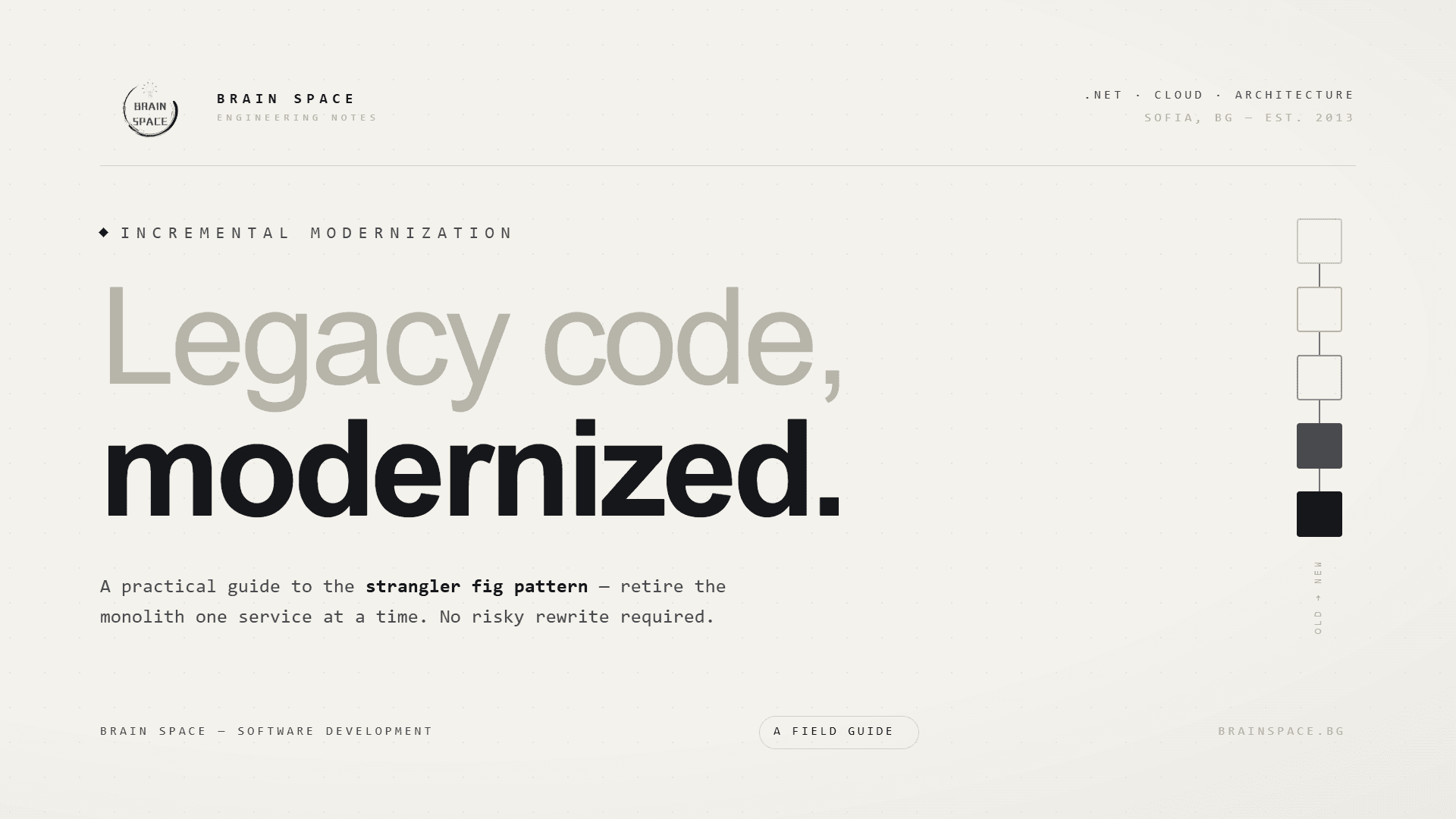
The strangler fig pattern — named after a tree that grows around and eventually replaces its host — is the most reliable approach to legacy modernization. The idea is simple: build new behavior alongside the old system, route traffic gradually, and retire the old parts only after the new ones are proven.
In .NET terms, this often looks like:
1. Introduce an anti-corruption layer — a boundary that translates between the old system's data model and the new one, preventing old design decisions from leaking into new code
2. Extract one domain or service at a time — start with the highest-pain, lowest-risk area (usually something with clear inputs and outputs, like a reporting module or notification system)
3. Run both in parallel briefly — compare outputs, validate correctness, build confidence
4. Cut over and remove the old path — only after the new path is stable in production
What to Prioritize First
Not all legacy code is equally worth modernizing. Prioritize by business impact:
- High-change areas: Code that developers touch frequently but fear — this is where investment pays off fastest
- Integration points: Old APIs, SOAP services, or FTP-based data exchanges that block new features
- Bottlenecks: Monolithic modules that force serialized development when multiple teams need to work in parallel
- Compliance risks: Areas with hard-coded business rules that may no longer be legally correct
Avoid starting with infrastructure or "plumbing" code that works but looks ugly. It works. Leave it.
The Role of Tests in Legacy Modernization
You cannot safely modernize what you cannot test. The first investment in a legacy system should be characterization tests — tests that document what the system currently does, not what it was supposed to do. These tests become your safety net, catching regressions before they reach production.
The sequence matters:
1. Write characterization tests around the area you plan to change
2. Refactor or rewrite in small steps, keeping tests green
3. Add new tests as new behavior is introduced
4. Delete the old code only when tests prove the new code covers it
Common Mistakes That Make Things Worse
- Mixing modernization with new feature work: Every change should have a single purpose. Refactoring and feature development in the same branch creates untraceable risk.
- Updating too many layers at once: Changing the database schema, the business logic, and the API contract simultaneously is how migrations fail. One layer at a time.
- Skipping documentation: If you're the only one who understands what you changed, you've just created new legacy code with a newer date.
When to Bring in Outside Help
Some legacy systems are best modernized with a team that has done it before — not because the work is impossible, but because the patterns of what to prioritize, what to defer, and what traps to avoid aren't obvious the first time through.
At Brain Space, legacy system assessments and incremental modernization projects are among the most common engagements we take on. If your team is facing this, get in touch — sometimes a second pair of eyes on the architecture is enough to unlock months of progress.
Brain Space is a Sofia-based software development company with over a decade of experience in .NET, cloud, and custom business systems. brainspace.dev