Platform Modernization Cost Factors That Matter
A modernization budget can look reasonable until the first production dependency appears: an undocumented batch job, a customer-facing integration with no contract, or a database that has quietly become the system of record for three other applications. Platform modernization cost factors are rarely limited to rewriting an application. They reflect the work required to preserve business continuity while changing the architecture, operating model, and risk profile of a live system.
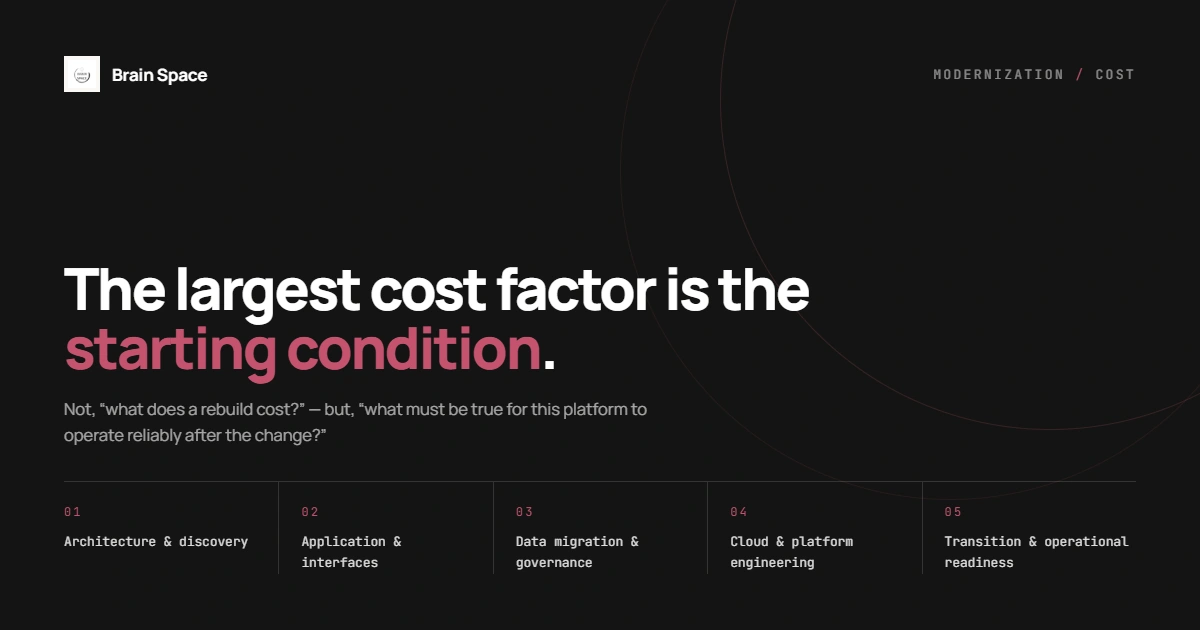
For technology leaders, the useful question is not, "What does a rebuild cost?" It is, "What must be true for this platform to operate reliably after the change?" That framing produces a more accurate plan and avoids the false economy of funding only the visible development work.
The largest cost factor is the starting condition
Two platforms with similar feature sets can have radically different modernization costs. The difference is usually not programming language or screen count. It is the condition of the current estate and the degree to which its behavior is understood.
A well-bounded application with automated tests, clear interfaces, current documentation, and a stable deployment process can often be modernized incrementally. An application with shared databases, manual releases, embedded credentials, and years of undocumented exceptions requires investigation before a responsible team can estimate delivery with confidence.
This discovery work is not overhead. Engineers need to identify runtime dependencies, data ownership, traffic patterns, failure modes, security controls, and operational runbooks. They also need to establish which behaviors are intentional and which are accidental but relied upon by users or downstream systems. Skipping that work may reduce the initial statement of work, but it moves uncertainty directly into implementation, where it is more expensive to resolve.
The same applies to code quality, although teams often overemphasize it. Difficult code raises the cost of change, but unclear business rules and hidden integrations are frequently the larger problem. A legacy service can be refactored. An unknown dependency can cause an avoidable production incident.
Platform modernization cost factors across the delivery lifecycle
A credible budget accounts for the full path to production, not just the build phase. The major categories are connected, and reducing one without understanding the others can create cost elsewhere.
Architecture and technical discovery cover system mapping, target-state design, domain boundaries, integration patterns, security requirements, and migration sequencing.
Application and interface delivery includes refactoring, replacement, API design, compatibility layers, automated testing, and user-facing changes where workflows must evolve.
Data migration and governance includes profiling, cleansing, reconciliation, historical retention decisions, data contracts, and validation of pipeline behavior.
Cloud and platform engineering includes environments, infrastructure as code, network design, identity, secrets management, CI/CD, observability, backup, and recovery.
Transition and operational readiness includes parallel runs, cutover planning, incident procedures, performance testing, support enablement, and post-release stabilization.
The proportions vary. A customer portal with modest data complexity may spend more on product delivery and identity integration. A data-intensive operational platform may spend more on schema evolution, pipeline reliability, lineage, and reconciliation. A regulated environment may require greater investment in controls, auditability, and evidence collection.
A plan that treats these items as optional add-ons tends to underestimate both cost and schedule. Production-grade delivery means the platform can be deployed, observed, recovered, secured, and supported by people other than the engineers who wrote the first version.
Data is often the budget breaker
Application teams can usually define a target architecture relatively quickly. Data takes longer because it exposes the history of the business. Duplicate records, inconsistent identifiers, overloaded fields, missing ownership, and conflicting definitions are common in established platforms.
The core decision is rarely whether data can be moved. It is what data should move, what quality threshold is acceptable, and how correctness will be proven. Migrating every historical record may be necessary for some businesses, but it can also add substantial cost with limited operational value. Archiving older data behind a controlled access path may be more practical.
Data migration also creates a timing problem. If the legacy platform remains active during delivery, new and changed records need a synchronization approach. Depending on the system, that can mean dual writes, change data capture, event streams, scheduled replication, or a short cutover window. Each option has trade-offs between complexity, operational risk, and downtime.
For data platforms, modernization can extend beyond migration into new governance practices. Lakehouse storage, streaming pipelines, and data contracts improve reliability when adopted with clear ownership. They do not solve ambiguity by themselves. Budget for the work of defining authoritative sources, validating transformations, and monitoring freshness and quality in production.
Cloud costs are an architecture decision
Moving workloads to AWS, Azure, or GCP does not automatically reduce operating cost. Cloud spend depends on workload shape, availability targets, storage patterns, network traffic, managed-service choices, and engineering discipline.
A lift-and-shift migration may be the fastest route away from aging infrastructure, but it can preserve inefficient sizing and operational practices. A more deliberate redesign can reduce long-term effort through managed services, autoscaling, and standard deployment patterns. It also has a higher upfront cost and needs stronger architecture decisions early.
Resilience requirements deserve explicit treatment. Multi-region deployment, cross-region data replication, active-active traffic management, and aggressive recovery objectives can be appropriate for a revenue-critical platform. They are not free. The business should decide what downtime and data loss are tolerable, then fund the architecture that meets those targets. Building enterprise-grade resilience for a low-criticality internal tool is unnecessary. Treating a critical platform as if it can tolerate ad hoc recovery is equally costly when an incident occurs.
Cloud financial operations should be part of the modernization scope. Resource tagging, ownership, budget alerts, capacity review, and cost visibility make spend manageable after launch. Without them, a technically successful migration can create a new operational problem for finance and engineering.
Delivery model changes the risk-adjusted cost
The cheapest day rate is not necessarily the lowest cost of modernization. Large programs fail or stall when responsibility is fragmented between application developers, cloud specialists, data teams, security reviewers, and an internal group trying to coordinate all of them.
A delivery model should match the platform's complexity. For a contained service, a focused team may be sufficient. For a business-critical platform, the work usually needs accountable technical leadership across architecture, engineering, infrastructure, data, quality, and operations. The cost includes coordination, but the alternative often appears as delayed decisions, incompatible designs, rework, and releases that cannot be safely operated.
Team continuity matters as well. Modernization programs accumulate context: why a boundary was chosen, how a reconciliation rule works, what a fallback procedure requires. Frequent handoffs lose that context and make every new issue slower to resolve. A senior delivery team that owns outcomes can reduce client-side management effort, but only if its scope includes the decisions and operational responsibilities that determine those outcomes.
Sequence work to control spend and uncertainty
A fixed estimate is most reliable when the unknowns are already small. Many legacy platforms do not meet that condition. The practical answer is not to avoid planning. It is to plan in stages.
Start with a focused discovery and architecture phase that produces a dependency map, target architecture, migration approach, delivery roadmap, and prioritized risk register. This gives leadership a basis for funding the next tranche of work rather than committing the entire program against assumptions.
Then modernize in slices that produce usable capability. A strangler approach can route selected functions from a legacy system to new services over time, reducing the need for a single high-risk cutover. It introduces temporary integration complexity, so it is not always the right choice. When the legacy platform is too unstable or the data model must change fundamentally, a planned replacement and controlled cutover may be safer.
Each release should include measurable exit criteria: performance under expected load, migration reconciliation results, security validation, observability coverage, recovery testing, and a clear ownership model. These controls cost time, but they turn progress into evidence rather than optimism.
Budget for the platform you intend to run
The most useful modernization estimate separates one-time transformation work from the recurring cost of operating the target platform. It should make assumptions visible: expected transaction volumes, retention needs, recovery objectives, integration count, release frequency, and the internal teams available to support the system.
That transparency allows leaders to make deliberate trade-offs. They may choose a phased migration over a faster replacement, lower initial resilience targets for a noncritical workload, or retain a stable component while modernizing the surrounding platform. Those are sound decisions when they are explicit and supported by solid architecture.
A modern platform is not defined by the services selected or the age of its codebase. It is defined by whether engineers can change it safely, operators can understand it quickly, and the business can rely on it under real conditions. Budgeting for those outcomes is the clearest way to keep modernization from becoming another expensive handoff.