What Is Enterprise Application Architecture?
A customer portal can look modern and still fail the enterprise if it cannot retrieve accurate account data, honor access policies, withstand peak demand, or recover cleanly when a downstream service is unavailable. That is the practical answer to what is enterprise application architecture: the disciplined design of how business-critical software, data, integrations, infrastructure, and operating practices work together as a dependable system.
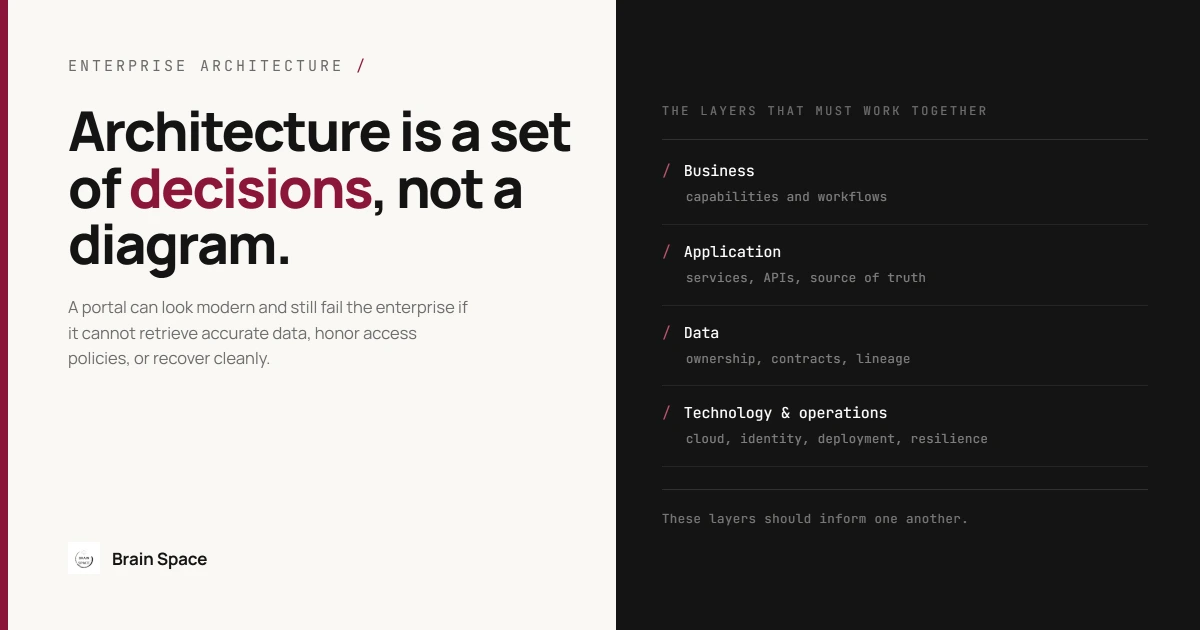
For technology leaders, architecture is not a diagram created before development starts. It is a set of decisions that shape delivery speed, operational risk, cost, and the organization's ability to change. When those decisions are unclear or disconnected, teams can ship individual features while making the overall platform harder to run.
What Is Enterprise Application Architecture in Practice?
Enterprise application architecture defines the structure and governing principles behind a portfolio of applications that support core business processes. It establishes which systems own which data, how services communicate, where business rules live, how identities and permissions are enforced, and how workloads are deployed and operated.
The word enterprise matters. A standalone application can make local choices about its database, release process, and user model. Enterprise applications rarely operate alone. They exchange data with operational systems, analytics platforms, partner interfaces, identity providers, and other internal products. They must also meet requirements for security, auditability, availability, retention, and controlled change.
A useful architecture creates boundaries without creating unnecessary friction. For example, an order-management capability may own order state and expose it through documented APIs or events. A billing capability can consume the relevant information without reaching directly into the order database. That separation prevents hidden dependencies from becoming permanent constraints.
Architecture therefore covers more than application code. It includes the technical standards and operating model needed to keep software reliable after release. A sound design considers CI/CD pipelines, infrastructure as code, observability, incident response, backup and recovery, and capacity planning from the beginning.
The Layers That Must Work Together
Enterprise architecture is often described in layers. The labels vary, but the relationships are consistent.
The business layer describes capabilities and workflows: onboarding a customer, processing a claim, fulfilling an order, managing a subscription, or reconciling a payment. Starting here keeps technical choices tied to an outcome rather than a preferred framework.
The application layer defines the services, applications, APIs, and user interfaces that execute those workflows. It clarifies responsibility: which component performs a task, which system is the source of truth, and which integrations are contractual rather than informal.
The data layer governs operational data, event streams, analytical datasets, and the contracts that allow them to be used safely. It addresses data ownership, quality, lineage, retention, and the difference between a transaction record and a reporting-ready dataset. Many modernization programs fail here because applications are rebuilt while inconsistent data flows remain untouched.
The technology and operations layer covers cloud environments, networks, compute, storage, identity, deployment automation, monitoring, and resilience. This is where availability targets become real engineering choices. A service cannot credibly promise high availability if it depends on a single region, untested recovery procedures, or manual production deployments.
These layers should inform one another. A business process requiring near-real-time visibility may justify event-driven integration and streaming pipelines. A reporting process that can tolerate a daily refresh may not. The architecture should reflect the required behavior, not treat every workload as if it has identical needs.
The Decisions That Matter Most
The highest-value architectural decisions are usually the ones that are difficult to reverse later. They deserve explicit ownership and documentation.
System boundaries and ownership. Teams need a clear answer to who owns customer identity, product availability, pricing, or account status. Shared ownership sounds collaborative but often produces conflicting updates and unclear accountability. A defined system of record does not eliminate replication, but it makes replication intentional.
Integration patterns. Synchronous APIs are appropriate when a caller needs an immediate response. Events are often better for propagating changes to multiple consumers without tightly coupling their release schedules. Batch exchanges still have a place for certain finance, reporting, and migration workloads. The right pattern depends on latency, consistency, volume, failure behavior, and operational maturity.
Data contracts. Producers and consumers need agreed definitions for fields, schemas, semantics, and change management. Without contracts, a small change in one service can quietly corrupt reports or break downstream processes. Versioning and validation are not bureaucracy when they protect production dependencies.
Security boundaries. Identity, authorization, secrets management, encryption, audit trails, and data classification must be designed into the platform. Adding them after applications are already interconnected is slower, more expensive, and less reliable.
Failure and recovery. Distributed systems fail in partial and inconvenient ways. A dependency may time out while completing the request, an event may be delivered more than once, or a region may become unavailable. Architecture needs practical responses: idempotent processing, retries with limits, dead-letter handling, graceful degradation, tested backups, and measurable recovery objectives.
Architecture Is a Set of Trade-Offs, Not a Technology Catalog
A common mistake is equating enterprise architecture with microservices, containers, or a particular cloud provider. Those tools can be useful, but they do not replace architectural judgment.
A modular monolith can be the stronger choice for a product with a small engineering organization, evolving domain boundaries, and a need for fast, coordinated releases. It can preserve clear internal modules while avoiding the operational overhead of many independently deployed services. Splitting it prematurely may introduce distributed transactions, complex debugging, and a larger on-call burden before the business gains a meaningful benefit.
Microservices become more compelling when domains are stable enough to own independently, teams need separate deployment cadence, or individual workloads have distinct scaling and resilience requirements. Even then, service boundaries should follow business capabilities and data ownership, not arbitrary technical layers.
The same principle applies to cloud design. Multi-region deployment can reduce the impact of a regional outage, but it adds cost and complexity around data replication, routing, and operational testing. For some systems, a well-engineered single-region deployment with tested recovery is the responsible choice. The architecture should meet stated recovery and availability objectives rather than chase a generic definition of resilience.
How Enterprise Application Architecture Supports Delivery
Architecture earns its place when it makes delivery more predictable. That requires translating high-level principles into working engineering practices.
Teams need reusable patterns for authentication, API design, event schemas, logging, error handling, and deployment. They need automated checks that enforce the standards that matter, such as security scanning, contract validation, and infrastructure review. They also need exceptions to be visible and deliberate. A principle that cannot be applied in a delivery pipeline is unlikely to govern the system for long.
Observability is especially important. Logs, metrics, traces, dashboards, and alerts should make it possible to answer operational questions quickly: Which dependency is causing failures? Did a deployment increase latency? Is a queue backing up? Which tenant or workflow is affected? Production visibility is part of the architecture, not a later operations task.
Architecture should also reduce coordination costs. If every release requires several teams to inspect database tables, manually exchange files, or negotiate undocumented behavior, delivery slows even when each team is capable. Stable interfaces and explicit ownership let teams move independently without creating unmanageable risk.
A Practical Way to Assess the Current State
An architecture assessment should begin with real flows, not slideware. Trace a few high-value journeys from user action through applications, integrations, data stores, and operational controls. Include both the successful path and likely failure paths.
Look for unclear ownership, direct database dependencies, manual handoffs, unsupported components, inconsistent identity models, fragile batch jobs, and data transformations no one can explain. Then relate each issue to its business impact: delayed releases, unreliable reporting, failed customer transactions, excessive cloud spend, audit exposure, or slow incident recovery.
Prioritization matters. Replacing every legacy component at once is rarely feasible or wise. A staged modernization plan may first establish reliable deployment and observability, then place an API or event boundary around a constrained system, then move high-change capabilities to a more suitable platform. This approach improves control while preserving business continuity.
The work benefits from engineers who can connect application design to cloud operations and data behavior. A diagram is only credible when the team responsible for it can build, deploy, monitor, and recover the system it describes.
Architecture Should Make Change Safer
The most useful enterprise application architecture does not attempt to predict every future requirement. It creates enough structure that the organization can respond when requirements, scale, regulations, or operating conditions change.
That means defining ownership, designing honest interfaces, governing data deliberately, and treating production operations as part of delivery. The goal is not a perfect target-state diagram. It is a system that can keep moving without turning each important change into a high-risk coordination exercise.